As automotive electronic systems grow increasingly sophisticated, ECU faults, such as circuit burnout, program corruption, and component aging have become common issues in auto repair. ECU repair demands precise, professional tools and standardized equipment to ensure accurate fault diagnosis, safe disassembly, effective maintenance, and flawless programming restoration.
Most ECU failures stem from electrical faults, including short circuits, open circuits, abnormal voltage, and damaged circuit board traces. Basic electrical detection tools are used to preliminarily judge ECU circuit status and locate basic faults.
Digital Multimeter.
A high-precision digital multimeter is the most fundamental tool for ECU detection. Technicians can quickly rule out basic circuit faults such as power supply failure and grounding abnormality through multimeter detection, laying a foundation for subsequent in-depth repair.
Automotive Oscilloscope.
Automotive oscilloscope can effectively diagnoses abnormal signal faults that cannot be detected by multimeters, including signal delay, waveform distortion, and intermittent signal loss, which are common causes of subtle ECU failures such as vehicle jitter and intermittent stalling.
ECU Sensor Signal Simulator.
During ECU repair and testing, technicians can use ECU simulator to input standard analog signals to the repaired ECU, verify whether the ECU can receive and feed back signals normally, and judge whether the repair restores normal working performance.
Many ECU faults are also caused by program loss, data corruption, immobilizer lock failure, and chip parameter errors, which be solved by professional equipment.
Advanced OBD Diagnostic Scanner.
Professional OBD scanners, such as FNIRSI FD10, support full vehicle system diagnosis, fault code reading and clearing, real-time data stream viewing, and basic ECU reset functions. For minor ECU software faults, the scanner can directly complete online repair and parameter correction without disassembling the ECU.
ECU Programmer.
For faults such as ECU program crash, data loss, and anti-theft lock failure, the ECU programmer, such as KT200 II can rewrite the original factory data to restore ECU functions.
Battery Stabilizer.
ECU programming and flashing operations have extremely high requirements for voltage stability. The dedicated automotive battery stabilizer can provide constant stable voltage for ECU offline and online programming, avoid program loss caused by voltage instability, and ensure the safety and success rate of programming operations.
When the ECU has hardware faults such as chip damage, capacitor and resistor burnout, and PCB board trace breakage, Due to the small and precise characteristics of ECU internal electronic components, special precision tools are required.
Disassembly Tool Set.
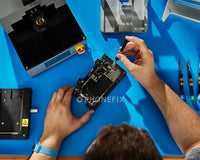
The ECU internal chip and wiring are delicate. A dedicated precision disassembly set includes multi-model special screwdrivers, anti-slip tweezers, plastic crowbars, and anti-static removal tools. It can safely disassemble the ECU shell without damaging tiny components, ensuring the integrity of equipment during disassembly.
Anti-Static Welding Station.
The anti-static constant-temperature welding station is specially used for welding ECU internal chips, resistors, capacitors and other components. It can effectively avoid static damage and excessive temperature burnout of the PCB board during welding. It is the essential tool for ECU hardware component replacement and circuit repair.
BGA Rework Station.
For the maintenance of core BGA packaged chips, BGA rework station is required. It supports precise heating, desoldering, soldering and ball planting of BGA chips, solves the faults of virtual welding and damage of ECU main chips, and realizes precision repair of core hardware.
Auxiliary Hardware Tools.
Including magnifying glass/microscope, solder wire, flux, cleaning agent, and insulating glue. These small auxiliary tools ensure the fineness and stability of ECU hardware repair, prevent secondary faults such as short circuit caused by residual dirt and poor welding.
The Electronic Control Unit (ECU) serves as the “brain” of modern vehicles, managing core systems including engine fuel injection, ignition timing, transmission operation, and vehicle safety controls. For auto repair technicians, having a professional and comprehensive set of ECU repair tools combined with mastery of standardized operating procedures will help them address increasingly complex vehicle electronic faults.
Essential Tools for Professional Automotive ECU Repair