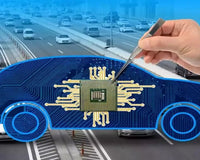
Under the hood of every modern vehicle, a tiny yet powerful component is quietly reshaping the future of mobility: the car ECU chip. It often referred to as the "brain" of the car, from engine management to advanced safety features, car ECU IC has become an essential part of automotive design.
Unlocking Engine Potential.
Car ECU chip is to manage the core operations of a vehicle’s powertrain, including fuel injection, air-fuel ratio, ignition timing, and boost pressure for turbocharged engines . Fuel efficiency is one of the most noticeable benefits of electronic engine management. Automotive ICs precisely control fuel delivery and combustion timing, ensuring optimal performance under varying conditions.
Core Functions Managed by Automotive ICs.
As the automotive industry marches toward autonomous driving, ECU tuning chips have evolved into high-performance computing hubs capable of handling the massive data loads and real-time decision-making required for self-driving features. Modern vehicles rely on hundreds of sensors generating continuous data streams. Integrated circuits analyze this data in milliseconds and adjust system behavior accordingly. This real-time processing leads to smoother acceleration, stable idling, improved fuel efficiency, and faster responses in critical situations. 
Optimizing Battery Life and Energy Efficiency.
In electric vehicles (EVs), auto ECU chips play a pivotal role in maximizing battery life and extending range. AI-enabled ECUs continuously analyze real-time data from battery sensors, temperature modules, and driving behavior to predict energy consumption patterns . By leveraging machine learning, they optimize charge/discharge cycles, adjust regenerative braking intensity, and modulate auxiliary loads to minimize energy waste.
ECU chips also support sustainability in traditional combustion engines by ensuring compliance with strict emissions regulations. They monitor exhaust gases via sensors and adjust engine parameters in real time to reduce harmful pollutants by up to 90%. 
Smart Car and Customization.
As the automotive industry moves toward electric vehicles, autonomous driving, and connected systems, the importance of integrated circuits will continue to grow. Future automotive ICs will handle even more complex tasks, including advanced sensor fusion and artificial intelligence-based decision-making.
Automotive ICs also enable performance customization. Through controlled adjustments, vehicles can be tuned for better throttle response, smoother power delivery, or enhanced driving dynamics.
As the automotive industry evolves toward electrification, intelligence, and sustainability, the role of ECU chips will only grow more critical. From boosting engine performance to powering autonomous driving and enabling connected, personalized experiences, ECU chips are the unsung heroes driving modern vehicle innovation. They enable precise control, real-time responsiveness, and intelligent system coordination that define today’s driving experience.
How ECU Chip Drive Modern Vehicle Innovation