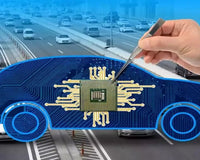
In modern automotive powertrains, the Electronic Control Unit (ECU) stands as the brain of the engine, orchestrating a symphony of operations to balance performance, fuel economy, and emissions. At the core of these systems lies the ECU Driver IC, an essential component that ensures accurate communication between the Engine Control Unit (ECU) and various engine actuators. Without its precision and reliability, even the most advanced ECU algorithms would fail to deliver optimal engine performance. 
At its heart, an auto ECU chip acts as a translator and amplifier between the ECU’s microcontroller and the engine’s mechanical actuators. The MCU processes data from dozens of sensors to calculate optimal control parameters, such as fuel injection volume, ignition timing, and EGR valve position. However, the MCU’s output signals are low-voltage, low-current digital signals, which are insufficient to drive high-power actuators that operate under harsh engine bay conditions.
This is where the ECU Driver IC steps in. It converts these weak control signals into robust, precisely timed power signals that can drive actuators directly. For example, when the MCU determines the need for a specific fuel injection pulse, the Driver IC amplifies this signal to control the fuel injector’s solenoid valve—ensuring the exact amount of fuel is delivered at the perfect moment. In essence, the Driver IC is the critical link that turns the ECU’s calculations into tangible, precise mechanical actions.
What are the advantages of ECU driver ICs?
The precision and reliability of ECU Driver ICs directly translate to measurable improvements in engine efficiency.
1. Enhanced Engine Performance: Accurate control of actuators ensures precise fuel delivery, ignition timing, and throttle response.
2. Optimized Combustion Efficiency: By ensuring precise fuel injection timing and volume, and accurate ignition timing, Driver ICs enable complete fuel combustion.
3. Smoother Driving Experience: Minimizes vibrations, misfires, and erratic engine behavior.
4. Reduced Emissions: Proper actuator control ensures complete combustion, lowering harmful exhaust emissions.
5. Extended Engine Longevity: Reduces mechanical stress on engine components by maintaining consistent performance.
In addition, ECU Driver IC can be utilized for performance tuning. Professional tuners can adjust fuel maps, ignition timing, and throttle response to maximize engine output. By precisely controlling actuators, the IC enables enhanced acceleration, torque, and engine responsiveness while maintaining reliability and compliance with emission standards.
As automotive technology advances, ECU Driver ICs are evolving to support smarter, more adaptive engine management systems. it’s clear that the ECU Driver IC is the unsung hero that makes modern, efficient engine control possible. Future ICs will likely integrate more advanced features, such as AI-driven adaptive control and enhanced connectivity, further pushing the boundaries of engine efficiency and sustainability.
How ECU Driver IC Enables Precise Engine Control and Enhanced Efficiency